

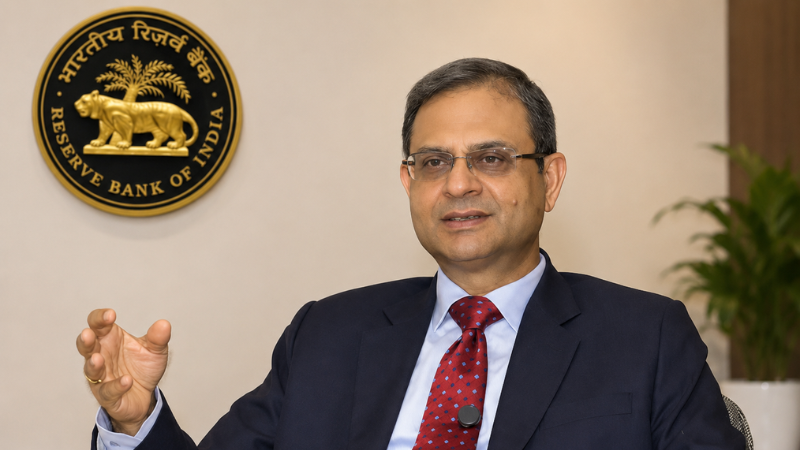
The Monetary Policy Committee maintained its neutral stance, and the RBI decided to wait for clear evidence on inflation, crude oil prices and monsoon conditions before changing interest rates.
Mumbai, August 5: The Reserve Bank of India kept the repo rate unchanged at 5.25% on Wednesday after the three-day RBI MPC meeting ended. All six members of the Monetary Policy Committee voted to maintain the current rate.
The committee also maintained a neutral stance on monetary policy. This gives the RBI room to hike, cut or hold rates at future meetings, depending on data on inflation and economic growth.
RBI Governor Sanjay Malhotra chaired the MPC meeting of the RBI, which took place from 3rd August to 5th August. The rate of the standing deposit facility is unchanged at 5 per cent, and the marginal standing facility rate and the bank rate remain at 5.50 per cent.
Why did the RBI keep the repo rate unchanged?
The decision was pretty much expected. Inflation has moved above the RBI’s 4% target, but the rise has been mainly fuelled by food and fuel prices. The central bank still lacks evidence that price pressures have broadened across the economy.
Retail inflation rises to 4.4% in June 2026. Core inflation, stripping out the more volatile food and fuel categories, stayed fairly tame. This gave the RBI some room to pause rather than immediately hike borrowing costs.
The central bank is also monitoring oil prices closely. Higher oil prices can raise the cost of transportation, manufacturing and imports. How much of this increase ultimately filters down to consumers will decide the RBI’s next move.
Governor Sanjay Malhotra said domestic demand was holding up, but the outlook was cloudy amid uncertainty over geopolitics, international trade and the monsoon.
RBI hikes growth forecast for FY27 to 6.7%
RBI has revised its real GDP growth forecast for FY27 upwards to 6.7% from the earlier estimate of 6.6%.
The central bank forecasts GDP growth of 7% in Q1, 6.4% in Q2, 6.5% in Q3 and 6.8% in Q4. “We are looking at 7.3% growth for 1QFY28.
The marginal upward revision is a reflection of the RBI’s confidence in the domestic economic activity amid pressure from global markets. The economy is being supported by consumer demand, investment, government spending on infrastructure and bank credit.
There are downsides, too. Indicators on manufacturing have weakened, and an uneven monsoon could hit farm output, rural incomes and food prices.
Inflation forecast cut to 5%
RBI has cut its average inflation projection for FY27 to 5% from the 5.1% projection announced in June.
CPI inflation is expected at 4.7% in the second quarter, 5.9% in the third quarter and 5.5% in the fourth quarter. The RBI projects inflation at 5.3% in the first quarter of FY28.
The central bank also cut its core inflation estimate to 4.3% from 4.7%. The Reserve Bank of India (RBI) said the recent rise in headline inflation has not yet translated into broad-based price pressure across goods and services.
Food prices remain the most volatile part of the calculation. The way rainfall distribution, crop output and government supply measures pan out could determine whether inflation remains within the RBI’s tolerance band of 2% to 6%.
What does RBI MPC decision mean for borrowers?
The flat repo rate means borrowers should not expect an immediate drop in EMI post the policy meet in August. Simultaneously, there is no new repo rate-driven hike in loan cost.
For those with floating home, vehicle or business loans tied to an external benchmark, interest rates are likely to remain broadly stable unless their bank alters its spread or other lending terms.
Fixed deposit rates too may stay at current levels in the near term. Individual banks will still retain the flexibility to change deposit and lending rates in accordance with their funding needs, competition and liquidity position.
The decision gives some certainty to prospective homebuyers. But for another round of cheaper loans to happen, it would need either a real rate cut by the RBI or a separate rate cut by banks, as borrowing costs have not gone up.
What will the RBI look at next?
The next few inflation numbers will be more important than usual. The RBI will be watching for signs that rising fuel or food prices are starting to spill over into higher wages, services and other consumer prices.
Crude oil prices, progress of the south-west monsoon and conditions in global financial markets will also have a bearing on the next policy decision. If inflation keeps rising, we might again discuss the rate hike. Stable oil prices and softer inflation would allow the RBI to wait it out.
The RBI MPC meeting minutes for August will be released on August 19, 2026. The next monetary policy committee meeting is scheduled to be held on 5 October to 7 October 2026.